EMS produces a cardiovascular response equivalent to structured exercise, measured at 2.5–7.7 METs.
Longdom, 2011Home / Technology
Hardware & TechnologyEngineering worn under every step.
A layered wearable system — conductive-fabric electrodes, dual-independent Bluetooth PCBAs, and precision regulated-voltage EMS pulse output — built around classical TCM foot reflex zones and modern safety engineering.
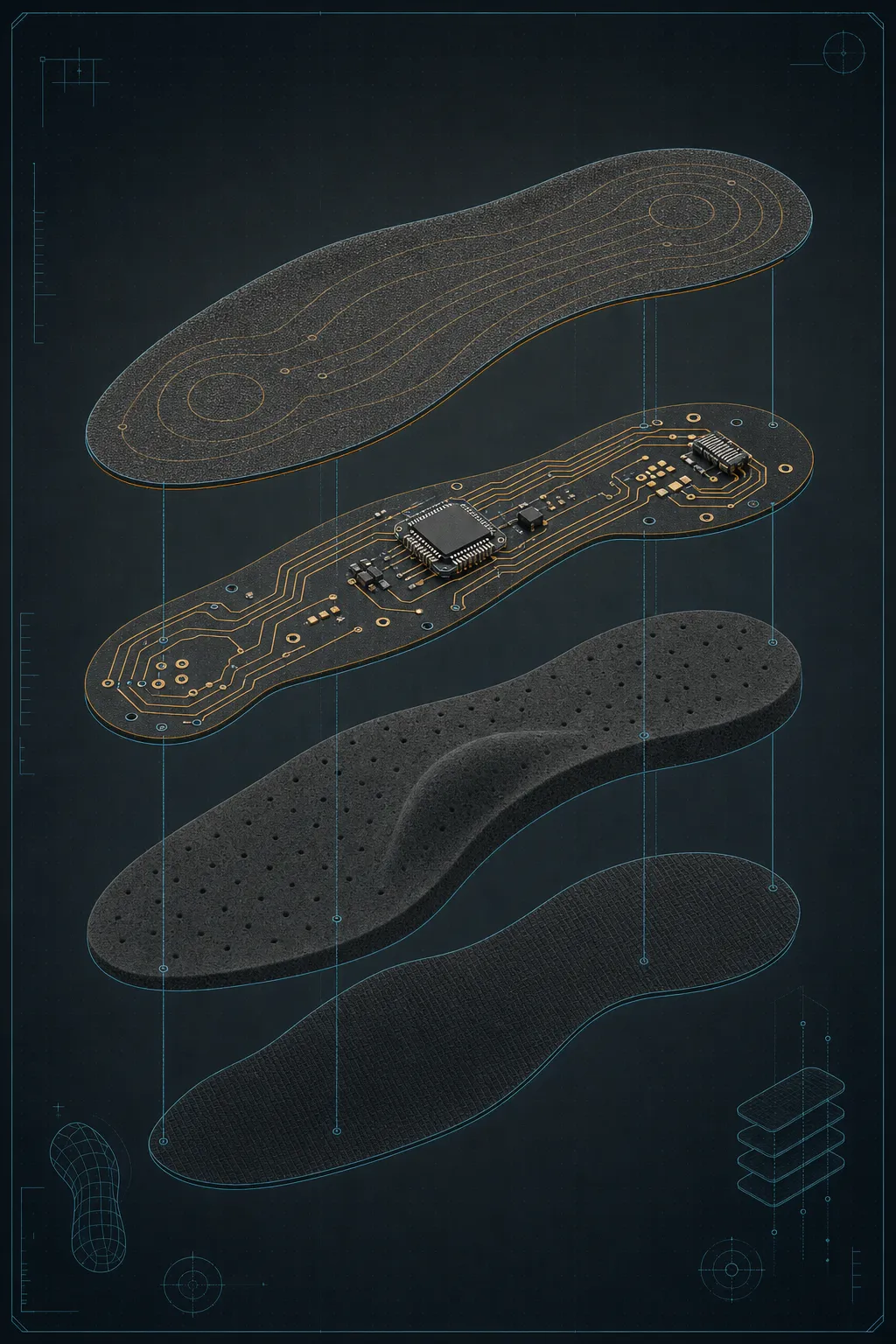
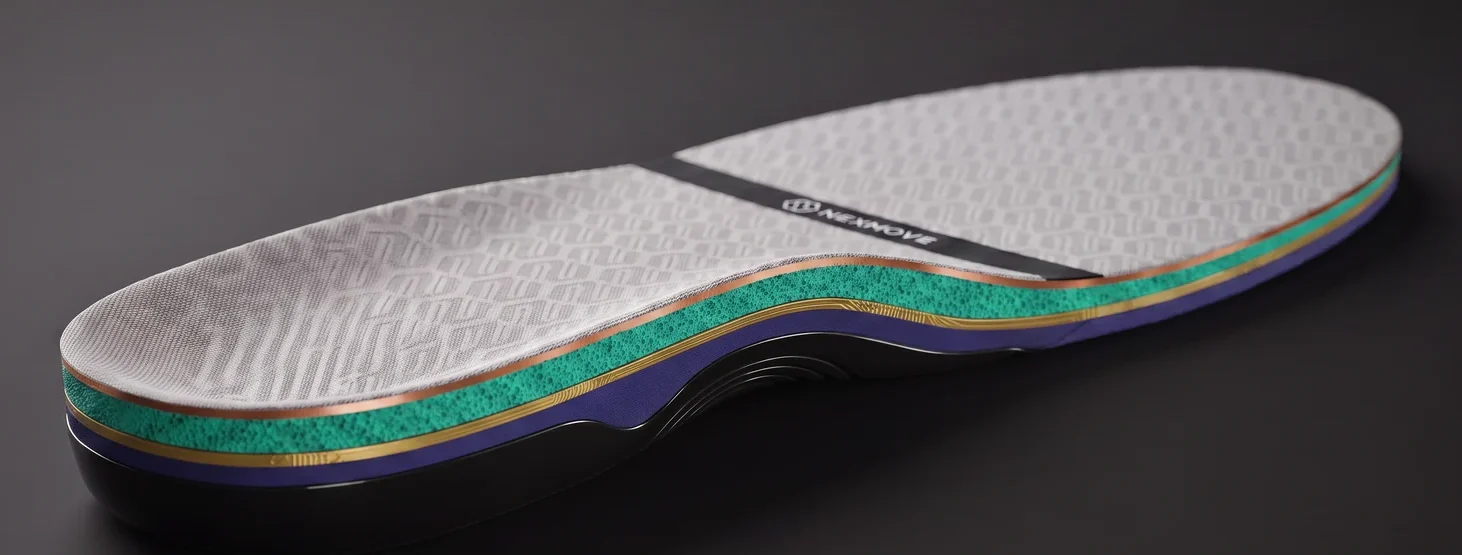
Colour-coded cross-section — each band is a separate material in the stack.
Construction
Six layers, one continuous circuit.
-
01
Conductive-fabric top layer
A woven conductive surface split by a black insulating band across the midfoot, so the forefoot and heel zones of a single insole form two separately driven electrode fields.
-
02
Conductive ribbon layer
Two flat flexible conductors — one shaped to the forefoot electrode zone, one to the heel — carry current and signal up from the PCBA below. No loose wiring inside the insole.
-
03
2.5 mm performance foam
High-resilience breathable foam that wicks moisture and cushions impact, keeping the electrode layer in steady contact through a full day of wear.
-
04
PCBA & battery — physically separated
The circuit board and the battery sit in two independent pockets rather than one rigid block, so the insole still flexes naturally with every step.
-
05
Moulded PU arch-support board
High-performance polyurethane with a gently raised arch contour for flat-foot support, precision-milled with a square pocket for the PCBA and a rectangular pocket for the battery — hardware you never feel.
-
06
TPU protective bottom cover
A moulded shell over the heel and arch that adds a second physical barrier around electronics already sealed to IP65, reinforces the PU board, and extends the working life of the insole.
These output-safety protections are described in Nexmove's patent draft and presented here as an engineering safety feature, not an independently certified medical claim.
Proprietary Architecture
No master. No slave. Two independent brains.
Most connected insoles pair one side as a relay for the other. Nexmove's left and right insoles each carry their own Bluetooth 5.4 radio, PCBA, and battery — fully independent, with no master-slave relationship — while remaining synchronized and individually controllable from a single companion app.
Patent-pending technology. Nexmove's dual-independent Bluetooth architecture, magnetic charge alignment, motion-based wake/sleep, and six-waveform mode system are covered by a filed patent application.
5.4Bluetooth Standard
2×Independent BLE Radios
QRPairing Method
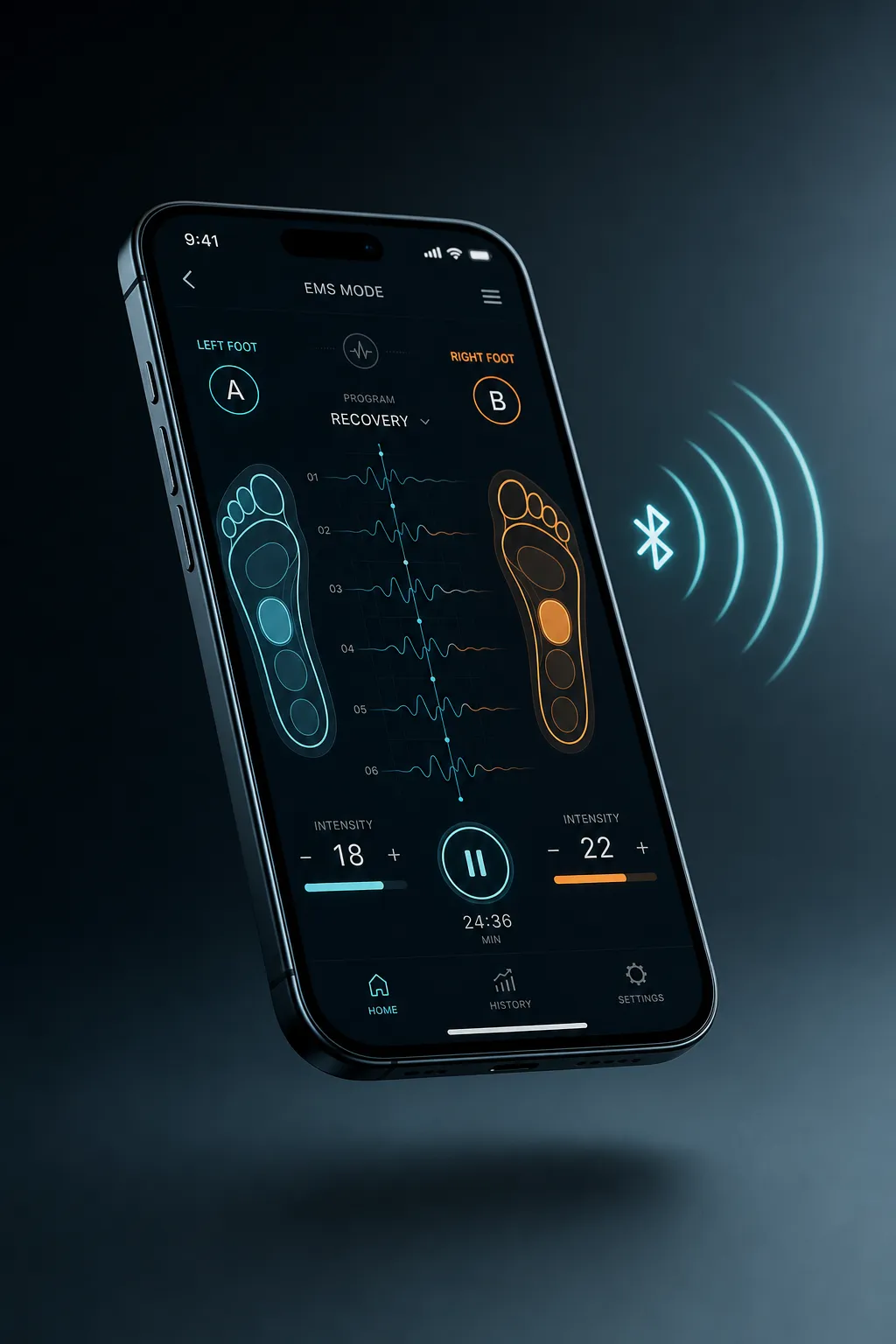
90 Combinations
Six modes. Fifteen intensities. One app.
Every mode targets a different rhythm and frequency range, echoing distinct traditional Chinese massage techniques translated into programmable EMS waveforms.
Acupuncture
5–15 HzDeep-focus pulses for sleep preparation and slow-wind-down sessions, mirroring the gentle, sustained stimulation of acupuncture practice.
Use case: Deep focus / sleep prepClassic Massage
10–25 HzThe daily default — a balanced, all-purpose pulse pattern suited for everyday wear and general relaxation.
Use case: Daily defaultTapping
30–50 HzBrisk, percussive pulses designed as a morning energizer to wake the feet before the day begins.
Use case: Morning energizerTuina
15–30 HzFirmer, kneading-style pulses aimed at recovery and deep tension release after a long day on your feet.
Use case: Recovery / deep tensionGua Sha
20–40 HzA scraping-style rhythm inspired by traditional Gua Sha technique, intended for a detox reset and circulation support.
Use case: Detox reset / circulationCirculation
5 × 10 sNot a mode of its own — it steps automatically through the first five modes, ten seconds each, looping continuously. Designed as an end-of-day flow to close out long standing or travel days.
Use case: End-of-day flow
Full Specification
Everything a distributor needs to know.
| Connectivity | Bluetooth 5.4, dual-independent per insole, QR-code app pairing |
|---|---|
| Massage system | 6 modes × 15 intensity levels (90 combinations) |
| Power | Magnetic charging cable (included); full charge ≈ 90 minutes; ≈ 14 days of daily 15–20 minute sessions |
| Automation | Accelerometer-based motion wake/sleep, power-saving auto-off timer |
| Electrode surface | Conductive fabric mapped to TCM foot reflex zones; six-layer construction with independent forefoot and heel electrode fields |
| Output | Precision regulated-voltage pulse output with a safety current cap, plus over-current / over-voltage / short-circuit / over-temperature protection |
| Sizing | XS (EU 35–37) · S (38–40) · M (39–41) · L (42–44), trimmable toe edge |
| Water resistance | IP65 dust-tight & water-jet resistant |
| IP status | Patent-pending — utility model and broader invention patent application filed |
| Standards | Engineered to CE / RoHS / CCC design standards |
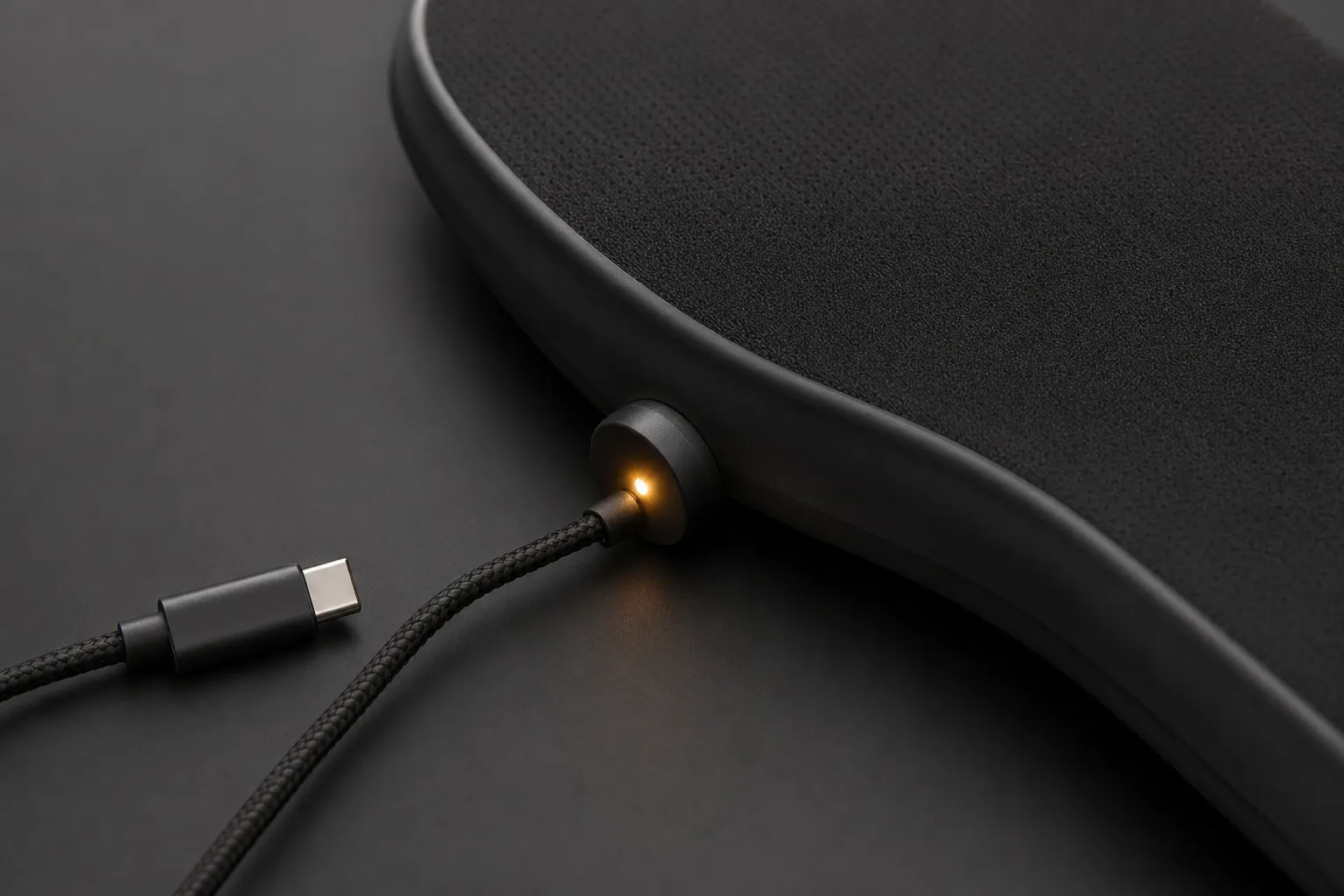
Magnetic charge alignment removes guesswork — align, click, charge.
Research & Evidence
From Galvani's spark to a Bluetooth app.
Electrical muscle stimulation has a documented research history spanning sports science, medical rehabilitation, and home wellness.
1780s
Galvani's discovery of bioelectricity lays the scientific foundation for electrical muscle stimulation.
1960s
EMS enters sports science and Olympic-level athletic training programs.
1970s
Clinical adoption expands into medical rehabilitation settings.
2000s
Compact EMS devices reach the home-wellness consumer market.
2020s
Bluetooth- and app-connected EMS wearables — including Nexmove — bring precision control to everyday wear.
EMS improved vascular endothelial function through nitric oxide release.
PLOS ONE, 2022EMS increased cardiac output and stroke volume while lowering peripheral resistance.
PLOS ONE, 2017Further supporting evidence on EMS physiological response and application.
PMC, 2023Sources: Longdom (2011) longdom.org · PLOS ONE (2022) journals.plos.org/plosone · PLOS ONE (2017) journals.plos.org/plosone · PMC (2023) ncbi.nlm.nih.gov/pmc
Safety Engineering
Designed with protective limits, not just power.
Nexmove's output circuitry uses precision regulated-voltage pulse output with a safety current cap, plus layered protections against over-current, over-voltage, short-circuit, and over-temperature conditions. These protections are described in Nexmove's patent draft and presented as engineering safety features. A constant-current version is planned for launch next year.
Nexmove is a wellness-grade device, not a medical device. It is not intended to diagnose, treat, cure, or prevent any disease. See full safety notices and contraindications on the Support & FAQ page.
Ready to bring Nexmove to your market?
Request the full technical dossier and wholesale conversation.